The World is Too Much With Us

The world is too much with us; late and soon,
Getting and spending, we lay waste our powers…
- William Wordsworth (1807)
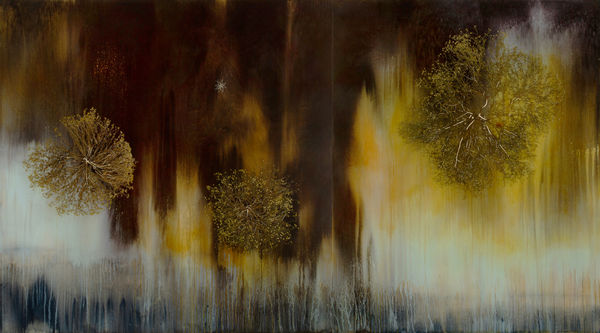
In the early years of the Industrial Revolution, Wordsworth's 1802 sonnet laments humanity's sudden turn toward novel technologies and meaningless commerce, a shift of human attention away from the unknowable systems and fierce beauty of the natural world. As a contemporary response, The World Is Too Much With Us at Lisa Sette Gallery features new works by Binh Danh, Ala Ebtekar, Timothy Horn, Alan Bur Johnson, Mayme Kratz, David Kroll, Carrie Marill, Marie Navarre, Beverly Penn, and others; whose works examine the parallel changes taking place in our own era. Lisa Sette Gallery's timely and stunning collection of contemporary nature-inspired works recalls Wordsworth's message that it is to our benefit to remain intimately connected to the primordial forces that shaped us, the "Sea that bares her bosom to the moon/The winds that will be howling at all hours." Centuries removed, the sonnet's message remains urgent and clarifying, and the artists of The World Is Too Much With Us express it through a variety of conceptual and material modes.




FOR IMMEDIATE RELEASE: July 1, 2026
Exhibition Dates:
October 17 - December 30, 2026
Opening Reception with artists:
Saturday, October 17, 2026
1:00 - 3:00pm
The world is too much with us; late and soon,
Getting and spending, we lay waste our powers…
In the early years of the Industrial Revolution, Wordsworth's 1802 sonnet laments humanity's sudden turn toward novel technologies and meaningless commerce, a shift of human attention away from the unknowable systems and fierce beauty of the natural world. As a contemporary response, The World Is Too Much With Us at Lisa Sette Gallery features new works by Binh Danh, Ala Ebtekar, Timothy Horn, Alan Bur Johnson, Mayme Kratz, David Kroll, Carrie Marill, Marie Navarre, Beverly Penn, and others; whose works examine the parallel changes taking place in our own era.
Lisa Sette Gallery's timely and stunning collection of contemporary nature-inspired works recalls Wordsworth's message that it is to our benefit to remain intimately connected to the primordial forces that shaped us, the "Sea that bares her bosom to the moon/The winds that will be howling at all hours." Centuries removed, the sonnet's message remains urgent and clarifying, and the artists of The World Is Too Much With Us express it through a variety of conceptual and material modes.
Moon, sea, and winds are present in the atmospheric canvases of Ala Ebtekar, composed of cyanotype prints that Ebtekar exposes via the sun or moon, in seasonal or poetic cadences, paired with traditional Persian patterning depicting the sky and clouds. Inspired in part by the works of 11th-century Islamic philosopher Suhrawardi, who examined humanity's relationship to light, Ebtekar's works are made possible through the cosmic position of the earth. Humanity's abiding need for illumination is revealed as a conduit to deep planetary time.
Many of the artists of The World is Too Much With Us consider the connection between biological life and human aesthetic intent-the ways we are affected by and look toward natural systems even in the process of constructing our human-ordered objects. Beverly Penn, a creator of startling and voluminous cast bronze arrangements of found botanical specimens, states that she "imagines and depicts aspects of Nature that we actually cannot see, like root systems and fungal networks, as a way of calling attention to the magic and mystery of the unseen and yet most important systems that keep our planet alive." The exquisite beauty of plant geometries, and their aching fragility under the stressors of human impacts, is also the subject of Timothy Horn's coral-inspired assemblies of metal and pearl, while ironsmith and sculptor Kim Cridler focuses on the vessel as a timeless form that holds the human need for both functionality and ornamentation.
A juxtaposition between the universal truths of nature and the contemporary attention economy is also present in the exhibit's works: Alan Bur Johnson, whose delicate constructions of framed photographic transparencies both depict and present the images of insect swarms and wings, remarks, "I could stare into my computer screen all day, every day, strategizing my path to success and greater popularity. I might even make more money if I did. But, all that would be reflected in my eyes would be me staring at myself in the screen. In contrast, I view the circular images in my work as the reflections of nature in my eyes."
In diverse mediums, the still-life painter David Kroll, photographer Marie Navarre, and sculptor Mayme Kratz each consider the information that we receive from nature as mediated through limited human concepts of time, sentience, and storytelling. The duality between our perception of the natural world and the timeless workings of natural systems, as in Kratz's resin-encased found objects; the strangely elastic moments of memory and the passage of time, in Navarre's contemplative photo collages; and David Kroll's delicate realism depicting otherworldly narratives in which human aesthetic impulse is mediated through the existence of the wild and mysterious biological designs of nature.
Such examples of human nature in dialogue with the sublime and unknowable natural world are given poignant consideration in The World Is Too Much With Us. The exhibit's work presents abundant evidence that even in times of miraculous technology, humans will always exist in a state of unbreakable connection to the earthly systems that birthed us. The World is Too Much With Us will open to the public with a reception with artists on October 17, and will be on exhibit until December 30, 2026.


